
Italian mechanical engineering: exports and domestic market down

Published the 05/12/2025
Italian mechanical engineering: exports and domestic market down

According to the 2025 forecasts of the Anima Confindustria Research Office, the sector should close the year in the red (-1.4%). Almici «A critical scenario that requires targeted interventions by institutions

On the occasion of the event organized by Anima Confindustria at the Marriott Hotel in Milan, "How to support the competitiveness of the mechanical engineering industry", the Federation provided a detailed overview of the forecasts for the production and exports of various mechanical engineering for 2025. The data presented clearly speak of a slowdown that has continued for two years and reflects the negative influence weighing on the industrial sector, resulting from geopolitical tensions, the imposition of trade duties and the volatility of international markets.

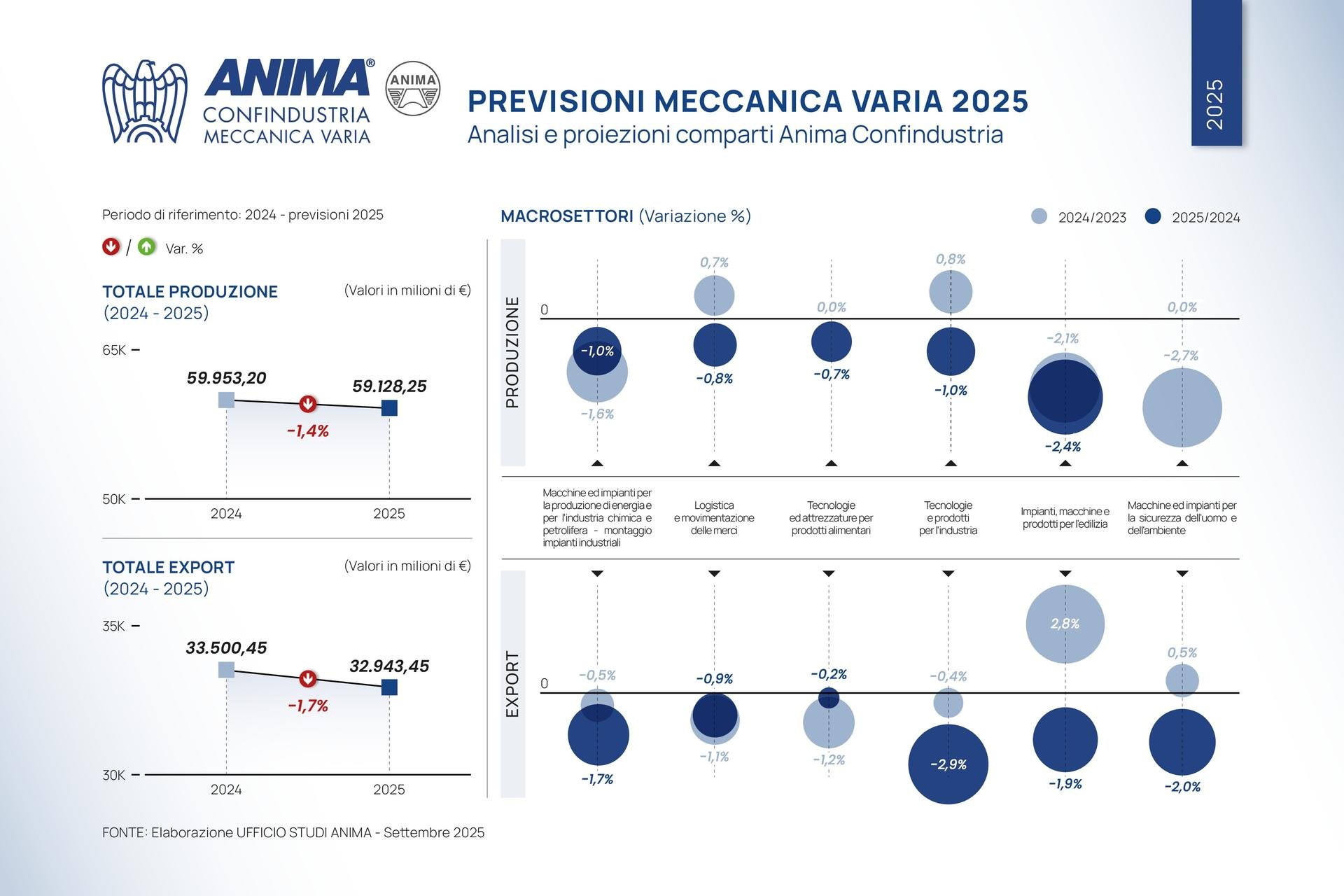
The overall production of the sector will reach 100 million euros in 2025. an estimated value of 59.1 billion euros, recording a contraction of 1.4% compared to 2024 and confirming the second consecutive year of decline - after the 1.3% drop recorded in 2024 compared to 2023. None of the six macro-sectors represented by Anima recorded growth compared to the previous year, a clear sign of the seriousness of the situation.

On the export front, Italian mechanical engineering exports are estimated at 32.9 billion euros in 2025, a decrease of 1.7% compared to 2024. This is therefore a worsening compared to the weak positive signal of last year, when exports had recorded growth of 0.7%. This last figure is crucial, as exports remain the driving force of the sector, with a share of turnover destined for international markets exceeding 55% of total production. The contraction represents a significant threat to the competitiveness of Italian industry and, consequently, to the national trade balance.

The main sector by turnover within Anima Confindustria is declining. Construction plants, machinery, and products, a sector worth over €20 billion, are down 2.4% compared to 2024, with exports down 1.9%. Food industry technologies and equipment are down 0.7%, while the logistics and goods handling sector is expected to close the year with a decline of 0.8%. A negative year is also forecast for industrial technologies and products (-1.0%). Going into detail, the sector of machinery and systems for energy production and for the chemical and petroleum industries, production is estimated at 16.5 billion euros in 2025, marking a decrease of 1.0% compared to 2024. Exports of the same sector will suffer a contraction of 1.7%, reaching 9.6 billion euros.

The most stable sector is expected to be that of machinery and systems for the safety of people and the environment. Production is expected to be 5.1 billion euros in 2025, a slight decrease (-0.05%) compared to 2024, with domestic market growth impacted by exports falling by 2.0%.

On the employment front, the entire sector represented by Anima is expected to have over 224,000 employees in 2025, recording a reduction of 0.1% compared to 2024. Although this decline is minimal, it testifies to the sector's continuing difficulty in maintaining employment levels.

The president of Anima Confindustria, Pietro Almici strongly reiterates the need for decisive and coordinated intervention by Italian and European institutions. The mechanical engineering industry is no ordinary sector: it provides employment to more than 224,000 workers, generates a turnover of nearly €60 billion annually, and represents a significant portion of the entire national manufacturing GDP. Allowing this sector's competitiveness to decline further would mean watching, willfully helplessly, a potential decline that would threaten the country's economic prosperity. The Federation appreciates the growing recognition shown by institutions over the past year and calls for targeted interventions that concretely address current challenges: a coordinated response to US tariffs, the restoration of stable industrial policies to support innovation, and the constant involvement of trade associations in industrial decision-making processes.

Despite the complex scenario, Anima remains confident and emphasizes the tenacious ability of the Italian mechanical engineering industry to resist and face this difficult moment.

"Over the decades," Almici continues, "the sector has demonstrated its ability to adapt and innovate in response to various global crises. However, this resilience alone is not enough: it is vital that institutions provide the necessary support. The Transition 5.0 plan could have been a tool for recovery, but the exhaustion of funds and the subsequent closure of the plan have increased uncertainty for the entire manufacturing industry. The mechanical engineering sector, represented by Anima, remains the beating heart of the Italian economy, as well as the true driver of its global competitiveness. Protecting this reality represents a matter of national interest that requires the establishment of a different strategic vision and, above all, a concrete commitment from all institutional actors.

ANIMA Confindustria is the industrial trade organization that, within Confindustria, represents companies in the various and related mechanical engineering sectors, a sector that employs 224,006 people for a turnover of 59.1 billion euros and an export/turnover share of 56% (Anima Research Office 2025 forecasts). The macro-sectors represented by ANIMA are: construction and infrastructure; handling and logistics; food production; energy production; industrial production; safety and environment.


For more information: ANIMA Confindustria

Other articles that may interest you

In 2025, exports of valves and taps reached €6.2 billion (+5.2% compared to 2024). exports of valv

AVR – Italian Valve and Tap Manufacturers Association – will be a key player at MCE – Mostra Convegno Expocomfort, held from March 24th to 27th in Milan. In 2025, after years of contraction, exports of valves and taps for civil use to Germany will return to positive territory, with a value of 153 million euros and a growth of 12% compared to 2024 and +20% compared to 2020. Saudi Arabia is the leading destination country in terms of revenue, followed by the United States and China; Concerns remain high about the impact of geopolitical instability on strategic markets such as the Middle East, an area which overall is worth 874.9 million euros for the civil valves and taps sector alone; Other concerns include rising energy costs, currency instability, tariff uncertainty, logistical difficulties, the lack of real free movement of goods, and an unclear European regulatory framework, often perceived as poorly aligned with industry needs. AVR, in the presence of 13 international associations belonging to the International Valves and Taps Alliance, proposes to create the first "World Forum dedicated to valves and taps". The Italian valve and faucet sector remains a leading international player. According to data from the Statistics Office of Anima Confindustria, released by AVR —the Italian Valve and Tap Manufacturers' Association, affiliated with Anima —during MCE–Mostra Convegno Expocomfort , exports of the valve and faucet sector (which includes valves for construction, industrial valves, sanitary taps, and fittings) will reach nearly €6.2 billion in 2025, up 5.2% from 2024, with an estimated total turnover of €9.55 billion. Exports of valves and faucets for residential use alone exceeded €3.2 billion (+6% from 2024). Considering only residential valves and faucets, Saudi Arabia is the leading destination country in 2025, followed by the United States and China. Among the countries, the German market , after years of contraction, is returning to positive territory, with exports of €153 million and a 12% growth compared to 2024 and a 20% growth compared to 2020, reaffirming its position as the reference market for Italian exports of residential valves and faucets. This trend could offer a significant contribution to the European sector and offset, at least in part, the impact of geopolitical instability on strategic markets such as the Middle East , an area worth €874.9 million to Italy overall. Furthermore, among the countries that recorded the most positive export performances in 2025, Norway also stands out, with a 59% increase. Besides geopolitical instability and its impact on strategic markets, what other concerns do industry entrepreneurs have? 2026 will also see rising energy costs, currency instability, tariff uncertainty, logistical challenges, the lack of true free movement of goods, and an unclear European regulatory framework, often perceived as poorly aligned with industry needs. In a complex scenario like this, it is crucial to strengthen dialogue and collaboration beyond national borders, creating concrete opportunities for discussion and cooperation between businesses, institutions, and trade associations. The goal is to jointly address sensitive issues for the sector (such as PFAS, nuclear power, and lead) and identify common solutions and best practices, recognized and adopted internationally. It is precisely in this direction that AVR is committed to creating the first Global Forum dedicated to valves and faucets . This meeting aims to leverage international experiences and offer shared tools to address the main challenges common to all businesses operating in countries around the world. "The Italian valves and taps sector confirms its position as an international benchmark, thanks to highly specialized manufacturing capabilities, a strong focus on innovation, and a consolidated presence in key foreign markets, " stated Sandro Bonomi, President of AVR . " The 2025 data confirm the sector's solidity, but at the same time highlight how complex and constantly evolving the global landscape remains. In this scenario, for a highly export-oriented sector like ours, it is essential to be able to rely on conditions that support the competitiveness of companies and enhance their presence on international markets. The discussions launched at MCE with the International Valves and Taps Alliance are moving precisely in this direction: strengthening dialogue between the sector's key stakeholders and sharing a common vision of the industrial, technical, and commercial challenges that lie ahead." AVR is the federated industrial association of ANIMA Confindustria, representing Italian companies in the valve and faucet industry, with over 80 member companies. In 2025, the sector, which includes building valves, industrial valves, sanitary faucets, and fittings, is projected to generate revenues of €9.55 billion, with exports accounting for nearly €6.2 billion, more than 60% of total revenues (estimate by the Anima Confindustria Research Office). The member associations of the International Valves and Taps Alliance: AVR – Italian Valve and Tap Manufacturers Association, AGRIVAL (Spain), BVAA (UK), CIPHE (UK), EVOLIS (France), FLUIDEX (Spain), IAPMO (USA), JVMA (Japan), POMSAD (Turkey), SAI, Valves and Fittings (Sweden), SPAP (Poland), URS (Switzerland), VDMA (Germany), VMA (USA). ANIMA Confindustria Meccanica Varia is the trade organization within Confindustria (Italian Confederation of Mechanical Engineering) that represents companies in the mechanical and related sectors, a sector that employs 221,700 people, generates a turnover of €56 billion and accounts for 60% of exports (data from the Anima Research Office). The main sectors represented by ANIMA are: construction and infrastructure; material handling and logistics; food production; energy production; industrial production; and safety and environment.

02/04/2026 Read more

Transition 5.0, anima confindustria "the outcome of the meeting at mimit represents a fundament

A positive phase begins for businesses under the Transition 5.0 plan: after the meeting with Minister Adolfo Urso, the reinstatement of measures to support innovation was confirmed. The delicate issue of those who were excluded from the Transition 5.0 plan, that is, those businesses that validly submitted an application for tax credits after November 7, 2025, has been resolved favorably. The drastic 65% reduction in tax credits , envisaged by the latest provisions of the Fiscal Decree and which had generated strong concerns and protests in the industrial world, has been substantially overcome thanks to constructive dialogue between institutions and businesses. The meeting took place on April 1st at the MIMIT headquarters between Ministers Adolfo Urso, Tommaso Foti, Deputy Minister Maurizio Leo, Confindustria (Italian Industrialists' Confederation), and other business associations. During the meeting, the Government reaffirmed its commitment to upholding its commitments, confirming that all properly submitted applications will be accepted. This step allows for the continued investment and innovative projects that underpin the Transition 5.0 program , aimed at strengthening the competitiveness of the national manufacturing system. The restoration of financial support for businesses requires sufficient resources to ensure financial coverage of requests. Pietro Almici, President of Anima Confindustria, commented with satisfaction : "The outcome of this meeting marks a key milestone in the dialogue between institutions and business representatives. We especially thank Minister Adolfo Urso for his willingness to help and Marco Nocivelli , Vice President of Confindustria for Industrial Policies and Made in Italy, whose role was crucial in facilitating this collaboration. Maintaining our commitments to the Transition 5.0 plan is essential to allowing our companies to continue on the path of innovation and sustainability, essential elements for the growth of our industrial system. We now trust in the rapid publication of the implementing decrees relating to the Hyper-Depreciation program." ANIMA Confindustria is the trade organization within Confindustria that represents companies in the mechanical and related sectors, a sector that employs 224,006 people, generates a turnover of €59.1 billion, and accounts for approximately 60% of exports (2025 forecast by the Anima Research Office). The major sectors represented by ANIMA are: construction and infrastructure; material handling and logistics; food production; energy production; industrial production; and safety and environment.

02/04/2026 Read more

Steel exports to slow further in 2025

Exports decline for the third consecutive year. Analysis by the siderweb Research Office. Italian steel exports (iron and steel products, pipes, and other primary processing products) continued to decline in 2025. Last year, steel exports fell in value by 5.7% compared to 2024, from €20.9 billion to €19.7 billion. This is according to data published by Istat and revised by the siderweb Research Office . Results, caused by a progressive decline in both prices and quantities sold , which therefore record the third consecutive slowdown after the two-year growth period 2021-2022 (closed with +51.7% and +23.8%). Exports fell by the same amount as imports, which also dropped 5.7% (€21.1 billion). Italy thus confirmed its position as a net importer of approximately €1.4 billion. Looking at the data by province , we note that the top 20 steel provinces in Italy exported steel worth 16.3 billion euros, a 5.1% decrease compared to the 17.2 billion euros in 2024. The predominance of Lombardy's districts in the Top 10 is confirmed, consolidating the geography of Italian steel production hubs that was created after the 2008-2009 crisis. Higher-than-average changes were recorded in Genoa (+8.3%), which rose to 18th place; Ravenna (+7.7%), which rose to 11th place; Verona (+5.5%), which dropped one place to 12th; and Brescia (+2.0%), which remained stable at the top. The provinces that showed the most significant declines were Mantua (-14.9%), which dropped one position to fourth place; Milan (-12.8%), which remained stable in sixth place; Lecco (-12.1%), which fell to ninth place; and Aosta (-11.8%), which remained in 13th place. The top three thus saw a shift compared to 2024: the province of Brescia remained in first place, followed by Udine and Cremona. Brescia sold €1.9 billion worth of steel outside Italy, up 2% compared to 2024. Supporting the partial recovery of the Brescia hub, after last year's declines, were positive performances in all three export categories: steel products (+0.5%), pipes (+7.4%), and other steel products (+4%). Udine comes in second, with a value of €1.8 billion, a decline of 4.7%. This result has caused the Friulian province to widen its gap with Brescia, with the difference between the two areas increasing from approximately €3 million to €127 million. The declines are due to a contraction in shipments of steel products (-4.3%) and other steel-processing products (-8.2%). Finally, the province of Cremona moved up one position compared to 2024 (overtaking Mantua) and recorded exports worth €1.5 billion, a 2.8% annual decrease. In particular, the Cremona hub saw an increase in sales of steel products (+3.2%), which mitigated the more than 8% decline in pipe exports. Taranto (home to Acciaierie d'Italia) remained outside the Top 20 for the second consecutive year. Its export value fell from 362 million euros in 2022, to 281 million in 2023, to 70.4 million euros in 2024 (-75%) and to 42.0 million in 2025, a 40.3% drop compared to the previous year. Terni (home of Arvedi Ast) gained ground thanks to a decline in exports (-7.3%), less than that of the Lecco hub (-12.1%). Exports of steel products decreased by 7.8% and those of pipes by 20.8%, while sales of other primary steel processing products increased by 19.7%. Livorno (where JSW Steel Italy operates in Piombino) dropped from 23rd place in 2024 to return to the Top 20, ranking 19th. In 2025, the Livorno hub's exports were valued at €188 million, down 4.6% due to slowdowns in steel products and pipe sales abroad.

27/03/2026 Read more
Subscribe to our newsletter
To stay updated on the latest news of the industrial world
Contact us
Image Newsletter Lindustriale
Dati Legali

L'industriale s.r.l.
P. IVA: 12212870153
Codice Fiscale: 12212870153

Sede Legale

Via Carlo Dolci, 32
20148 Milano (MI)
Italy

Registro Imprese

Iscrizione R.I.: 12212870153
REA: MI-1539011
Capitale sociale: Euro 10.400,00 i.v.

Top
This website is protected by reCAPTCHA, therefore the Google privacy policy and terms of service apply.