Artificial intelligence as a central theme at AMB 2026 // Guido Reimann, VDMA, discusses opportunities, challenges and current developments
At AMB, the international trade fair for metalworking, taking place in Stuttgart from September 15 to 19, 2026, Artificial Intelligence (AI) will be one of the three main topics, alongside automation and the circular economy. We discussed the progress made by the industry and the useful insights decision makers can draw from AMB 2026 with Guido Reimann. He is Deputy General Manager of VDMA Software and Digitalization and Coordinator of the VDMA Competence Network on Artificial Intelligence.
AMB: AI was a hotly debated topic at AMB 2024. Where does the metalworking industry stand today, in 2026? Has AI become a standard practice, or are pilot projects still prevalent?
Guido Reimann: For the mechanical and plant engineering sector in general, as well as for manufacturers of precision tools and machine tools, the topic of artificial intelligence has gained further importance. A VDMA survey in spring 2026 revealed that over 80% of mechanical engineering companies attach great importance to artificial intelligence technologies. Around a third of companies are already using AI solutions in production. This means the era of pilot projects is over. We are seeing increasing practical application of AI. Furthermore, many pilot projects continue to be conducted within companies to further familiarize themselves with the technology and test new application possibilities.
Current business application areas related to manufacturing focus on software development, engineering and design, business management, IT, marketing, and communications. Artificial intelligence solutions are also increasingly being used in sales and product-related services for customers in the mechanical engineering industry. To fully leverage their potential, companies must focus on their digitalization and promote it strategically.
AMB: The mechanical and plant engineering sector expects a tangible increase in efficiency thanks to AI. What specific figures and success stories do you know in the metalworking industry? And what are the main obstacles to implementation?
Guido Reimann: AI-based solutions and approaches not only promise increased efficiency, they also ensure it along the entire value chain. This is reflected, for example, in the reduction of costs for producing technical documentation and user manuals, in the time and cost savings in purchasing by increasing the number of identical components and thus improving purchasing conditions, or in the reduction of unplanned downtime, for example on machine tools, where cost savings of 10 to 20% are possible. Furthermore, AI solutions can significantly accelerate processes in many areas: development, production, sales, and customer service.
Comprehensive and sustainable digitalization is a fundamental prerequisite for the use of artificial intelligence and other digital technologies. However, obstacles often include change management, slow implementation, and a lack of human resources. Projects often fail less due to technical issues than to organizational difficulties, inadequate decision-making structures, poor engagement, insufficient knowledge of applications and limitations, and other non-technical factors. And even in the case of AI, it's true that not all pilot projects are successful. The crucial factor is knowing when to stop and redirect limited resources towards more effective digitalization activities.
AMB: Which AI technologies and application areas do you believe will dominate AMB 2026, and why is participation in AMB 2026 essential for metalworking professionals interested in AI?
Guido Reimann: In traditional product development and design, as well as in software development, we are now seeing numerous AI-based solutions offered by the software industry. At the same time, many mechanical engineering companies have integrated AI technologies into their related products or services, making them available for metalworking. At AMB, industry professionals will find not only manufacturers and suppliers of production machinery, but also software and service providers that support seamless implementation along the entire value chain.
AMB: Industrial AI, the European AI Regulation, humanoid robotics, quantum computing: the agenda is getting busier. What developments should decision makers in the metalworking industry definitely keep an eye on over the next five years?
Guido Reimann : It's true that the range of technologies, applications, and regulatory requirements relevant to the digital sector is constantly expanding. This also means that equipment manufacturers and application industries must keep pace with this change. Digital technologies are not only becoming increasingly important for internal business processes, but are also significantly influencing companies' business models. Those who are new to new digital technologies and their potential applications within their own company and in their customers' industries can lay the foundation for future success well in advance. A VDMA survey from spring 2026 also shows that mechanical engineering companies are focusing intensively on the following three technologies and intend to expand their use: artificial intelligence, digital twins, and open source software.
AMB: Thank you for the interview, Mr. Reimann.
Artificial Intelligence at the heart of the program
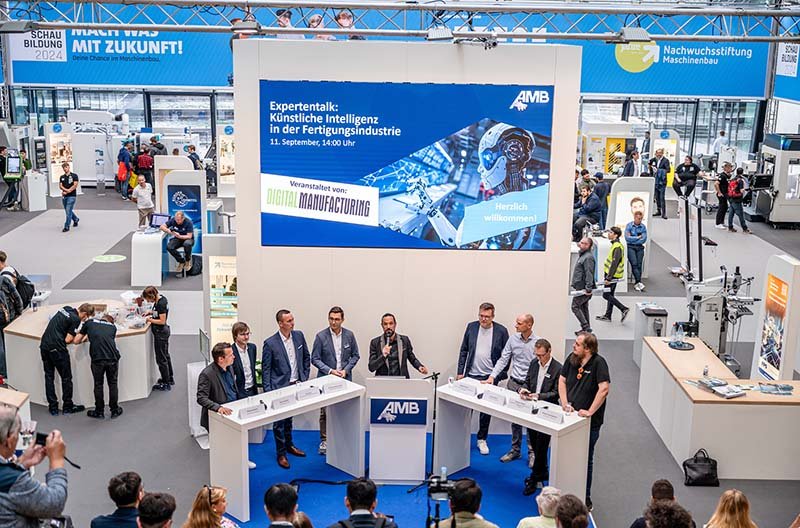
For those who want to delve deeper into the topic of AI at AMB 2026, not only by visiting the exhibition stands but also by interacting directly with experts, the AMB Stage offers two special opportunities on Wednesday, September 16: From 12:00 to 1:30 p.m., VDMA Software und Digitalisierung invites you to a panel discussion entitled "Artificial Intelligence in Production - Practical Examples." This will be followed at 2:00 p.m. by the presentation "AI in Production - From Impact to Added Value," featuring industry, research, and application professionals who will discuss current developments, concrete application examples, and open questions related to the use of AI in mechanical processing. The AMB Stage is located in the atrium (EO010) at the east entrance.
About AMB
Since 1982, AMB has presented the highlights of the international metalworking industry. "Where metal comes alive" will also be a regular event on the industry's agenda in 2026, this year from September 15 to 19. It is the international marketplace and meeting place for metal cutting, showcasing the latest products, technologies, innovations, services, and concepts in all their facets. AMB is supported by the VDMA Precision Tools, VDMA Software and Digitalization, and the VDW Verein Deutscher Werkzeugmaschinenfabriken e.V. (German Machine Tool Builders' Association). Further information is available at www.amb-messe.de/
Made in steel 2027 strengthens its international dimension: kallanish and smr partner to bring the g
From market analysis and trade flows to geopolitics and the green transition: the next edition expands the content program and introduces new formats for dialogue and in-depth analysis. Made in Steel 2027 brings a global discussion on the future of the steel industry to Fiera Milano. For the 2027 edition, the event, organized by siderweb in conjunction with Fiera Milano, has chosen to strengthen its international reach with two exclusive partnerships with Kallanish and SMR - Steel & Metals Market Research . The goal is to further expand the event's content offering and bring a global perspective to the program on the markets, commercial dynamics, and transformations reshaping the steel industry. "Made in Steel increasingly aims to be a place where the international steel industry can meet and exchange ideas," says Paolo Morandi, CEO of Made in Steel and siderweb. "The partnership with Kallanish and SMR goes precisely in this direction: bringing international expertise, analysis, and perspectives to Milan, creating opportunities for dialogue that can help operators understand an increasingly interconnected and complex market." "The European steel industry, " he adds, " is undergoing a profound transformation, in which competitiveness, trade, energy, decarbonization, and geopolitics are inseparable issues. Made in Steel aims to be a space where these dimensions can be addressed together, bringing together those who produce, process, and use steel, those who analyze scenarios, and those who define the rules." A new series of sessions dedicated to international markets, organized by Kallanish , will focus on three key areas shaping the steel industry: "Global Steel Market Outlook," "Trade and Competitiveness," and "The Future of Steel Production." Participants can choose to take one, two, or all three modules, which will cover global market developments, the changing trade and regulatory environment, and the future of steel production, from raw materials to artificial intelligence and digitalization. SMR - Steel & Metals Market Research is a market research firm specializing in stainless steel and specialty steels, led by Markus Moll. It will organize a conference dedicated to the global markets for carbon and alloy engineering steels, bearing steels, free-cutting steels, and tool steels. The program will provide insights into the global supply structure, trade flows and market volumes, and end-use demand by segment, including 10-year forecasts. The program will also include a global comparison of production costs and an assessment of geopolitical trends and their impact on the engineering steel industry. The new international partnerships will complement the already extensive Made in Steel conference program, curated by siderweb. Entrepreneurs, managers, experts, and representatives of the main industry associations will be invited to discuss issues affecting the future of Italian and European steel. Speakers will also include representatives of Assofermet, Eurofer, Eurometal, and Federacciai, as well as representatives of Italian and European institutions . New formats for dialogue and in-depth analysis The program's evolution also extends to content production and delivery. Made in Steel 2027 will go beyond the traditional conference format: among the new features, a live video-podcast station will be available, designed as an open space for meeting with industry professionals and as a place for content production during the event. The siderweb editorial team will engage in ongoing dialogue with representatives of the Italian and international steel supply chain, gathering testimonials, analyses, and perspectives directly from those attending Made in Steel. The production of podcasts, already part of siderweb's editorial offering, will also continue, strengthening the connection between the physical experience of the event and the digital enjoyment of its content. One of the new features of 2027 will be the arrival at Fiera Milano of “The Green Steel Challenge” , the podcast produced by the Willy Korf Foundation and Kallanish Commodities, which will make live recordings during the event. A new dimension for Made in Steel Made in Steel 2027 will increasingly be the place where the steel industry looks to the world to understand where it is going and to identify the next direction to follow. The partnerships with Kallanish and SMR are part of the event's broader growth path : the twelfth edition of Made in Steel, scheduled for 11, 12 and 13 May 2027 at Fiera Milano , presents itself with a renewed layout and expanded spaces in pavilions 8, 12 and 16 , designed to welcome an ever-increasing number of companies and promote visibility, networking and business opportunities along the entire steel supply chain. Following the growth of the 2025 edition, which attracted over 19,000 attendees and nearly 400 companies from all over the world, Made in Steel is looking to 2027 with the aim of further consolidating its role as a European platform for discussion, innovation, and development for the sector. Made in Steel is the international conference and exhibition dedicated to the steel industry. It is organized by siderweb - the steel community alongside Fiera Milano. Made in Steel is a conference and exhibition. It offers opportunities for business and reflection, networking and learning. It is both an exhibition showcase and a cultural hub that, with conferences, forums, and roundtables, aims to foster competitive collaboration and the exchange of information, essential elements for business growth. Since 2023, Made in Steel has been certified for sustainable event design and management according to the ISO20121 standard. siderweb - The Steel Community is the only online publication in Italy dedicated entirely to the steel industry. It is a point of reference for industry professionals, thanks to its simple style, focus on in-depth analysis, and objectivity. Since 2009, it has been tracking the prices of raw materials and steel products on the national market every week, now numbering over 60, using a method certified by the Laboratory of Statistics, Data, Methods, and Systems at the University of Brescia. Since 2022, it has published five weekly indices for scrap, carbon steel, long and flat products, and stainless steel. Since 2005, it has organized Made in Steel, the international Conference & Exhibition dedicated to the steel industry, and structured its contents: conferences, interviews, and outlooks.
 Industriale.it certification