How tool reconditioning reduces waste and improves manufacturing sustainability
Climate TRACE, an independent greenhouse gas emissions monitoring group, stated in an April 2025 report that 10.32 billion tons of carbon dioxide equivalent were emitted globally in the first two months of the year. The primary source of emissions is industrial waste, most of which ends up in landfill. Recycling, while a useful solution, does not solve all the problems. In this article, Patrik Eurenius, Head of Sustainability and EHS at Sandvik Coromant, a metal cutting specialist, explains why tool reconditioning is an alternative solution.
Global waste levels are rapidly increasing, and the UN predicts municipal waste will reach 3.8 billion tons by 2050. Currently, 50% of all municipal waste is industrial waste. To prevent this prediction from coming true, as well as to reduce global emissions, a more resource-efficient industry is needed.
Cutting tools are essential in industries such as aerospace, automotive, and the oil and gas industry, where they are subjected to extreme conditions such as high pressure, intense heat, and abrasive materials. Such a demanding working environment inevitably leads to significant wear, and some manufacturers tend to replace tools prematurely to avoid downtime.
Yet, their useful life may not yet be over. With a sound reconditioning strategy, a single machine tool can be used efficiently many times over.
How Reconditioning Works
Reconditioning a tool isn't simply a matter of resharpening it: it's a multi-stage precision process aimed at restoring a worn tool to its original geometry. This extends its lifespan and reduces dependence on raw materials, allowing manufacturers to fully exploit its technology.
First, the tool is thoroughly examined using advanced metrology equipment to evaluate wear patterns and structural integrity. This phase involves identifying defects such as flaking, cratering, and chipping. This is a crucial step, as it not only determines the areas requiring attention but also determines whether the tool is suitable for reconditioning.
If the assessment is successful, the next step is resharpening, performed on advanced CNC machines that restore the tool's cutting edges and geometric profile to within microns of the original specifications. During this phase, great attention is paid to managing thermal loads and maintaining precise alignment between the cutting edge and the central axis of the tool body to avoid compromising its structural integrity.
Next, a new coating layer is applied to improve resistance to heat, abrasion, and chemical wear using ultra-precision processes such as physical vapor deposition (PVD) or chemical vapor deposition (CVD). This ensures optimal uniformity and adhesion. PVD processes are typically the most commonly chosen for high-precision tooling because they require lower temperatures and, consequently, help prevent thermal deformation.
After regrinding and coating, the reconditioned tool undergoes stringent performance testing, including cutting edge integrity analysis, coating adhesion assessment, scratch resistance testing, and performance comparisons with new tools. All these tests mirror those performed on new tools and are designed to ensure that the reconditioned tool meets the original manufacturing standards in terms of performance, quality, and precision.
Once ready, the tools are cleaned and packaged for shipping in packaging that protects them from impact during transit. They are then returned to the customer, who can reuse them for high-precision, high-efficiency operations.
Beyond Performance
With its global network of reconditioning centers, Sandvik Coromant offers a complete end-to-end service. Beyond tool performance, these centers contribute to a more fundamental transformation of machining practices.
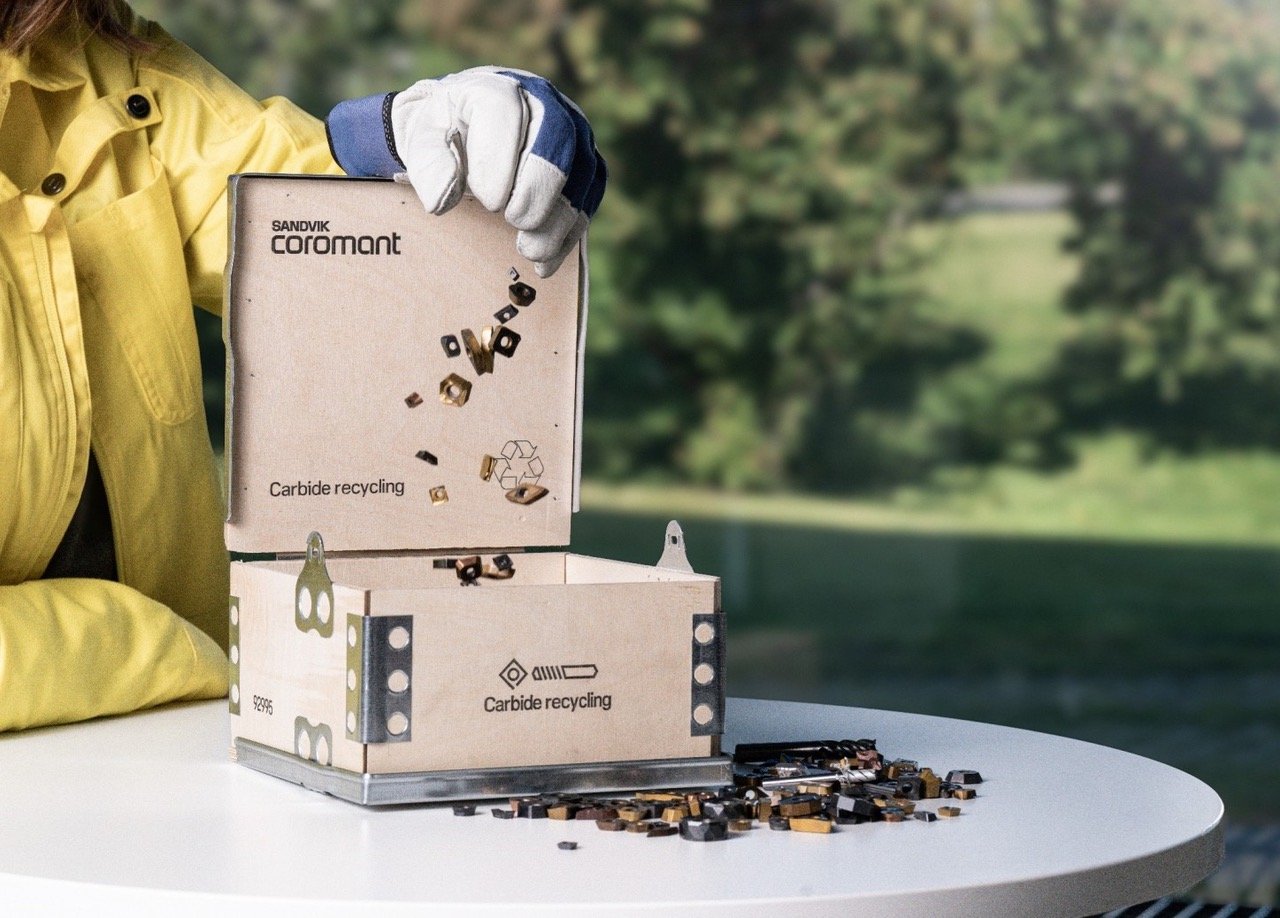
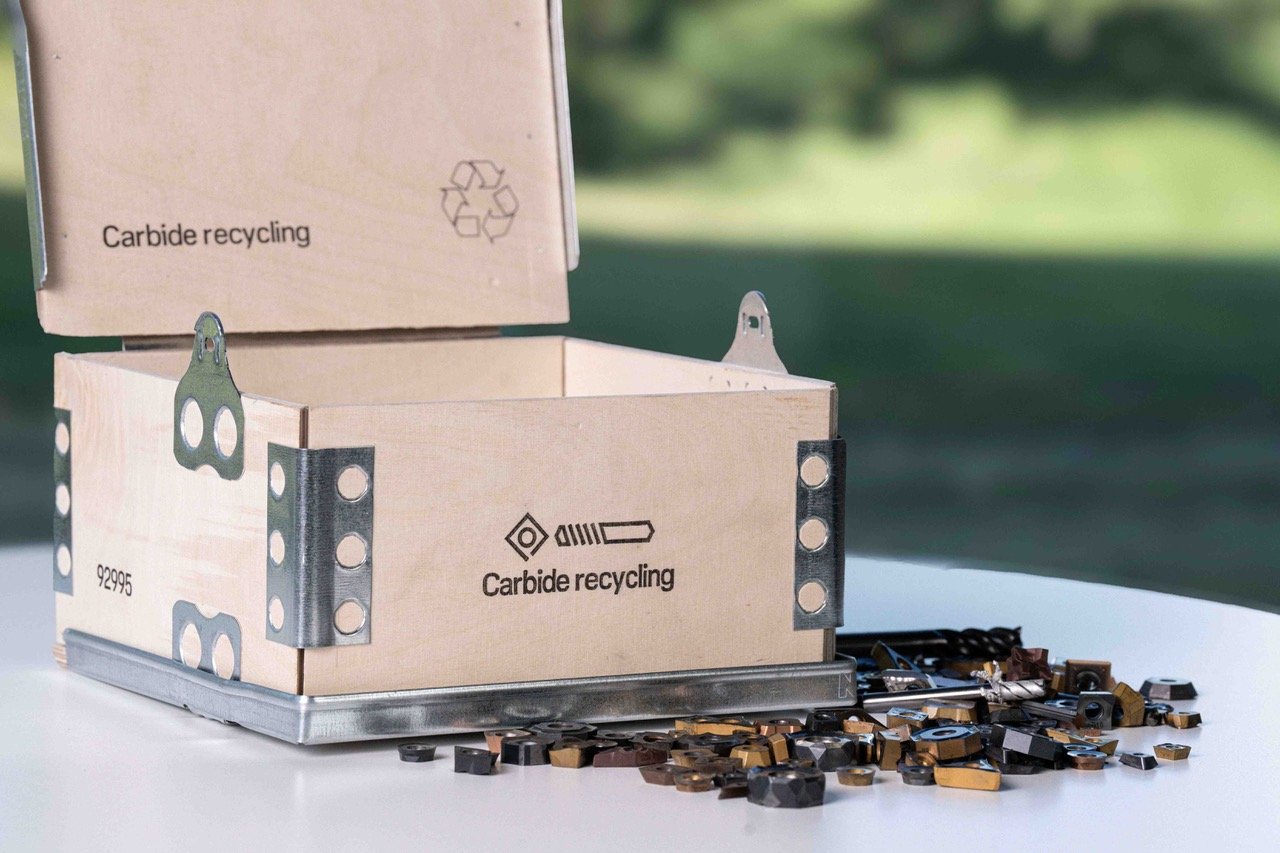
In addition to its reconditioning centers, Sandvik Coromant also has its own recycling scheme for carbide tools that are too worn to be reconditioned. At the recycling facility in Austria, these tools are collected and processed into new products, thus recovering valuable raw materials such as tungsten.
Thanks to its high melting point, remarkable strength, and high wear resistance, tungsten is a vital material in machine tools, particularly for high-performance alloys, which are increasingly used in the aerospace and automotive industries. However, tungsten reserves amount to only about 7 million tons, or 100 years of consumption. This makes Sandvik Coromant's recovery process almost indispensable not only for reducing the carbon footprint but also for promoting manufacturing progress.
Reducing waste is essential to limiting emissions and achieving climate goals. Remanufacturing helps manufacturers rethink their waste management processes, abandoning traditional consumption practices. Ultimately, this practice contributes to making the world more resource-efficient and environmentally resilient.
Sandvik Coromant
Together with our customers and partners, Sandvik Coromant provides tooling solutions to metalworking industries worldwide. Over eighty years of practical experience have allowed us to accumulate a wealth of knowledge in metal cutting and machining. This expertise transforms every challenge into an opportunity for innovation, collaboration, and cutting-edge solutions. Our goal is to pursue positive change by driving efficiency and growth to shape a future where innovation is at the forefront. Part of the global industrial engineering group Sandvik, Sandvik Coromant is committed to building the future, together with its customers.
For more information, visit www.sandvik.coromant.com or follow us on social media.
Climate TRACE, an independent greenhouse gas emissions monitoring group, stated in an April 2025 report that 10.32 billion tons of carbon dioxide equivalent were emitted globally in the first two months of the year. The primary source of emissions is industrial waste, most of which ends up in landfill. Recycling, while a useful solution, does not solve all the problems. In this article, Patrik Eurenius, Head of Sustainability and EHS at Sandvik Coromant, a metal cutting specialist, explains why tool reconditioning is an alternative solution.
Global waste levels are rapidly increasing, and the UN predicts municipal waste will reach 3.8 billion tons by 2050. Currently, 50% of all municipal waste is industrial waste. To prevent this prediction from coming true, as well as to reduce global emissions, a more resource-efficient industry is needed.
Cutting tools are essential in industries such as aerospace, automotive, and the oil and gas industry, where they are subjected to extreme conditions such as high pressure, intense heat, and abrasive materials. Such a demanding working environment inevitably leads to significant wear, and some manufacturers tend to replace tools prematurely to avoid downtime.
Yet, their useful life may not yet be over. With a sound reconditioning strategy, a single machine tool can be used efficiently many times over.
How Reconditioning Works
Reconditioning a tool isn't simply a matter of resharpening it: it's a multi-stage precision process aimed at restoring a worn tool to its original geometry. This extends its lifespan and reduces dependence on raw materials, allowing manufacturers to fully exploit its technology.
First, the tool is thoroughly examined using advanced metrology equipment to evaluate wear patterns and structural integrity. This phase involves identifying defects such as flaking, cratering, and chipping. This is a crucial step, as it not only determines the areas requiring attention but also determines whether the tool is suitable for reconditioning.
If the assessment is successful, the next step is resharpening, performed on advanced CNC machines that restore the tool's cutting edges and geometric profile to within microns of the original specifications. During this phase, great attention is paid to managing thermal loads and maintaining precise alignment between the cutting edge and the central axis of the tool body to avoid compromising its structural integrity.
Next, a new coating layer is applied to improve resistance to heat, abrasion, and chemical wear using ultra-precision processes such as physical vapor deposition (PVD) or chemical vapor deposition (CVD). This ensures optimal uniformity and adhesion. PVD processes are typically the most commonly chosen for high-precision tooling because they require lower temperatures and, consequently, help prevent thermal deformation.
After regrinding and coating, the reconditioned tool undergoes stringent performance testing, including cutting edge integrity analysis, coating adhesion assessment, scratch resistance testing, and performance comparisons with new tools. All these tests mirror those performed on new tools and are designed to ensure that the reconditioned tool meets the original manufacturing standards in terms of performance, quality, and precision.
Once ready, the tools are cleaned and packaged for shipping in packaging that protects them from impact during transit. They are then returned to the customer, who can reuse them for high-precision, high-efficiency operations.
Beyond Performance
With its global network of reconditioning centers, Sandvik Coromant offers a complete end-to-end service. Beyond tool performance, these centers contribute to a more fundamental transformation of machining practices.
In addition to its reconditioning centers, Sandvik Coromant also has its own recycling scheme for carbide tools that are too worn to be reconditioned. At the recycling facility in Austria, these tools are collected and processed into new products, thus recovering valuable raw materials such as tungsten.
Thanks to its high melting point, remarkable strength, and high wear resistance, tungsten is a vital material in machine tools, particularly for high-performance alloys, which are increasingly used in the aerospace and automotive industries. However, tungsten reserves amount to only about 7 million tons, or 100 years of consumption. This makes Sandvik Coromant's recovery process almost indispensable not only for reducing the carbon footprint but also for promoting manufacturing progress.
Reducing waste is essential to limiting emissions and achieving climate goals. Remanufacturing helps manufacturers rethink their waste management processes, abandoning traditional consumption practices. Ultimately, this practice contributes to making the world more resource-efficient and environmentally resilient.
Sandvik Coromant
Together with our customers and partners, Sandvik Coromant provides tooling solutions to metalworking industries worldwide. Over eighty years of practical experience have allowed us to accumulate a wealth of knowledge in metal cutting and machining. This expertise transforms every challenge into an opportunity for innovation, collaboration, and cutting-edge solutions. Our goal is to pursue positive change by driving efficiency and growth to shape a future where innovation is at the forefront. Part of the global industrial engineering group Sandvik, Sandvik Coromant is committed to building the future, together with its customers.
For more information, visit www.sandvik.coromant.com or follow us on social media.
For more information: Sandvik Coromant
 Industriale.it certification