DMG MORI and HAIMER strengthen their global strategic partnership

Published the 20/11/2025
DMG MORI and HAIMER strengthen their global strategic partnership

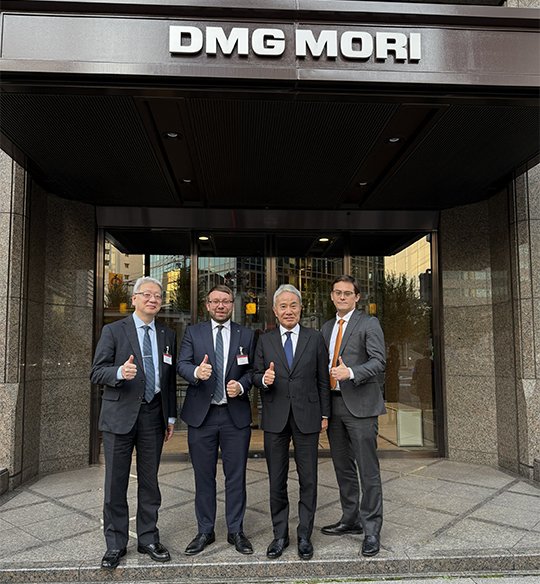
In the pitchure from left to right: Koichi Nosaka (President HAIMER Japan K.K.), Andreas Haimer (President Haimer Group), Dr. Masahiko Mori (President DMG MORI Co., Ltd.) and Kentaro Blu-men-stengel (Executive Director DMQP and President of DMG MORI Technium).

Integration of HAIMER »Tool Room of the Future» development at DMG MORI sites, including complete automation solutions in Iga and a joint global software distribution agreement.

DMG MORI Co., Ltd. and HAIMER GmbH  have announced an expansion of their long-standing strategic collaboration to accelerate the digitalization of tool rooms, automation, and global software distribution. The agreement extends joint activities to DMG MORI showrooms, technical centers, and production facilities worldwide, benefiting their joint global customers.

Successful machining requires both powerful machines and highly precise peripheral technology that ensures precision is transferred from the spindle to the cutting edge of the cutting tool. This is why the collaboration between DMG MORI, a global leader in machine tools, and HAIMER, a world leader in high-precision technology for tools, shrinking, presetting, and balancing, has been very successful and reliable for almost twenty years. This collaboration now incorporates the industry's evolution towards Machining Transformation (MX) and Digital Transformation (DX), adding the latest HAI-MER software to DMG MORI Qualified Products (DMQP) for worldwide resale. Dr. Masahiko Mori, President of DMG MORI Co., Ltd., emphasizes the next step of the partnership in general: "The close collaboration with HAI-MER as a long-term partner advances our MX and DX strategy by integrating world-leading shrinking, balancing, and presetting machines, including high-precision tools, tool room automation, and software solutions for our global customers. As a leading machine tool company, together with HAIMER, we offer comprehensive process integration and digital transformation in our DMQP program. This step will accelerate the connectivity of digital twins across our entire machine ecosystem." style="text-align: justify; ">For Andreas Haimer, President of the HAIMER Group, digital connectivity in HAIMER Tool Room solutions is key to the expansion of the partnership: 

»We will take our global partnership to the next level by implementing the »Tool Room of the Future« concept with i4.0 tool presetting, shrinking and balancing, including our digital tool and data management software Win-Tool and Tool Room Manager, as well as our intelligent sales solutions Tool-base in all DMG MORI facilities, showrooms and technology centers worldwide. Our joint customers will be able to easily purchase the complete HAIMER product range in the DMQP program via DMG MORI and integrate our products, with the option of financing, when investing in machine tools."

In detail, the agreement includes The implementation of the "Tool Room of the Future," the joint use of Industry 4.0 presetting, shrinking, and balancing solutions connected to HAIMER software, is taking place at DMG MORI's global headquarters in Tokyo, as well as at the main production sites in Iga (Japan), Pfronten (Germany), and other DMG MORI locations worldwide. In the HAIMER "Tool Room of the Future," every single assembly step is tracked, controlled, and validated by the Tool Room Manager software. Digital twins are created by WinTool, and assembly jobs, including cutting tool tolerances, are sent to the presetting, shrinking, and balancing devices for seamless data connectivity. Reordering cutting tools can be fully automated with Toolbase solutions.

Automation Cube One: A breakthrough for DMG MORI's Iga production facility

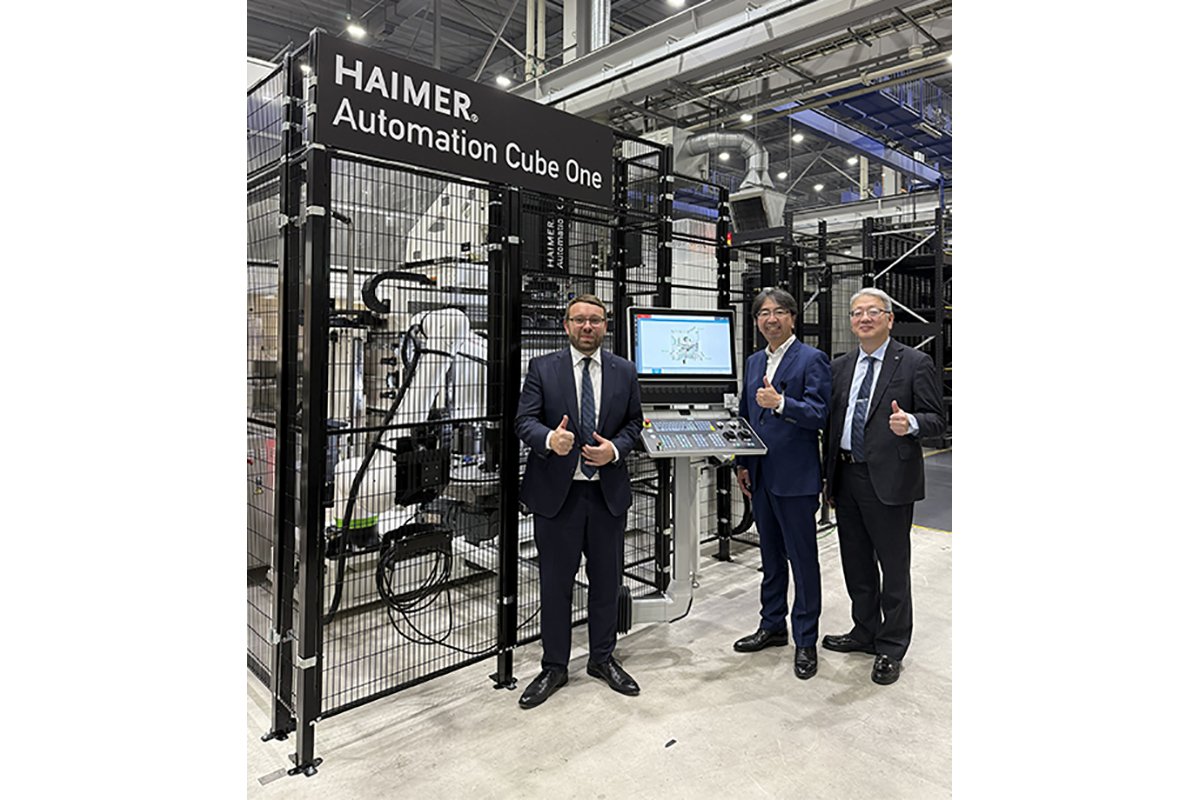
Furthermore, the HAIMER Automation Cube One was recently introduced at the Iga production facility for fully automated tool assembly with Magnescale components, ensuring maximum precision.

This automated shrinking and presetting cell with a 12-axis cobot is the ideal solution for reliable and efficient tool assembly in a high-volume production environment. In combination with the high-quality HAIMER shrink fit chucks, the installation of the HAIMER Automation Cube One has already proven to be a game changer for the Iga production site, as Kazutoyo Moriguchi, Senior Executive Officer Production Engineering and Vice President DMG MORI Iga Co. Ltd., explains.

»We have already achieved a significant increase in productivity of 30 percent and more in our production by switching from traditional Japanese milling systems and collet chucks to HAIMER shrink fit technology a few years ago. Now, with the investment in the Automation Cube One, we can take the next step, fully automating the Tool Room and working unmanned to close the skills gap."

Global distribution of HAIMER digital solutions by DMG MORI Technium

At the EMO Hannover 2025 trade fair, HAIMER, DMG MORI Technium and WinTool kicked off a strong partnership with the aim of shaping the future of digital tool management. WinTool, a new digital solution for tool and data management, was presented at the DMG MORI booth. DMG MORI Technium will resell this solution globally, providing digital tool management and digital twin connectivity to over 20 CAM systems for their joint customers. Kentaro Blumenstengel, Executive Director DMQP and President of DMG MORI Technium, emphasizes: "HAIMER has always been our most important DMQP partner for the automation and digitalization of tool rooms. We have now expanded this partnership with a global software distribution agreement through DMG MORI Technium to resell WinTool, Tool Room Manager and all HAIMER software solutions to our customers.

Benefits for Japanese and international customers

Summarizing the new level of partnership in Japan and globally, HAIMER Japan K.K. President Koichi Nosaka emphasizes the advantages of proven HAIMER solutions for increased process reliability and productivity on the shop floor, which have been demonstrated in recent Japanese customer success stories: 

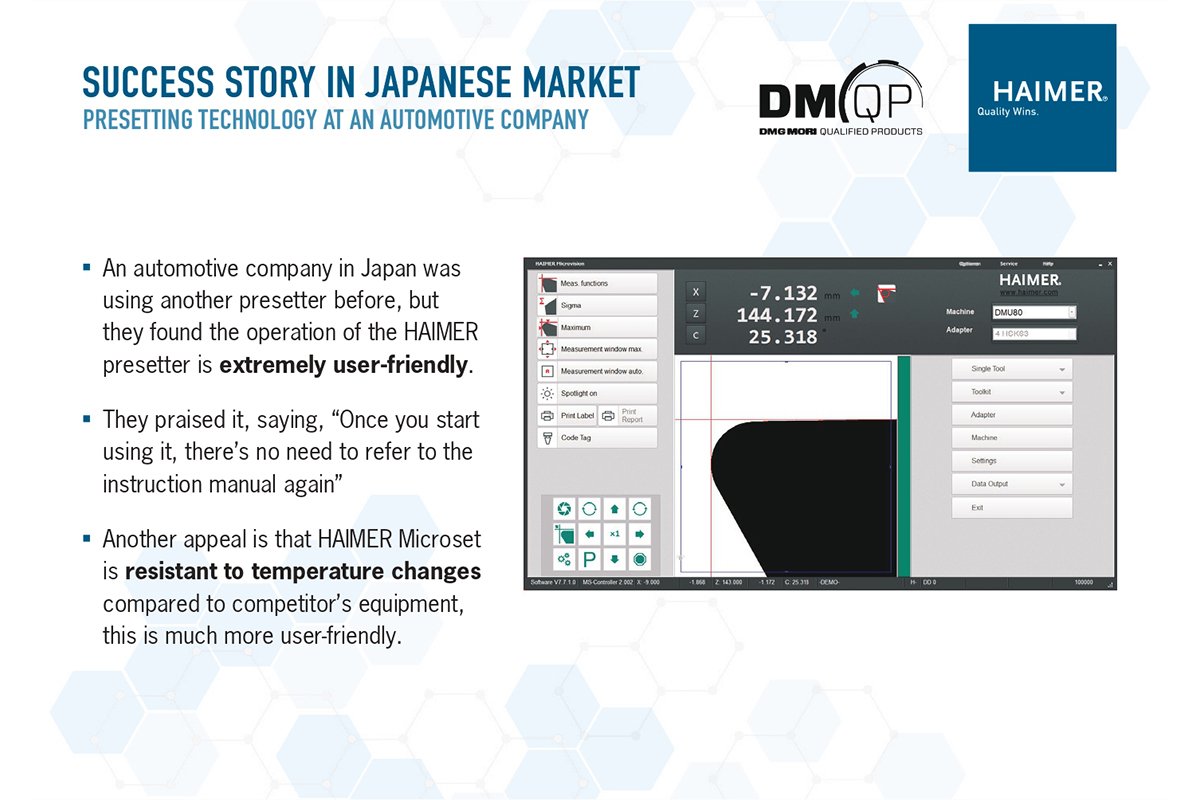
"Our Japanese and international customers can benefit from this partnership to easily access all our products through DMG MORI. We have seen this from customers It is common in Japan that HAIMER balancing systems have extended the service life of spindles in critical applications by up to 300%. Furthermore, the introduction of our Microset presetting technology at large Japanese automotive companies has led to higher precision, simpler software operation and significantly fewer calibration cycles thanks to the thermally stable cast iron base of our machines."

Automation Cube One

In combination with HAIMER shrink fit chucks, the HAIMER Automation Cube One has revolutionized the DMG MORI Iga production site. From left to right: Andreas Haimer (President of the Haimer Group), Kazutoyo Moriguchi (Senior Manager Production Engineering and Vice President DMG MORI Iga Co. Ltd.) and Koichi Nosaka (President HAIMER Japan K.K.)

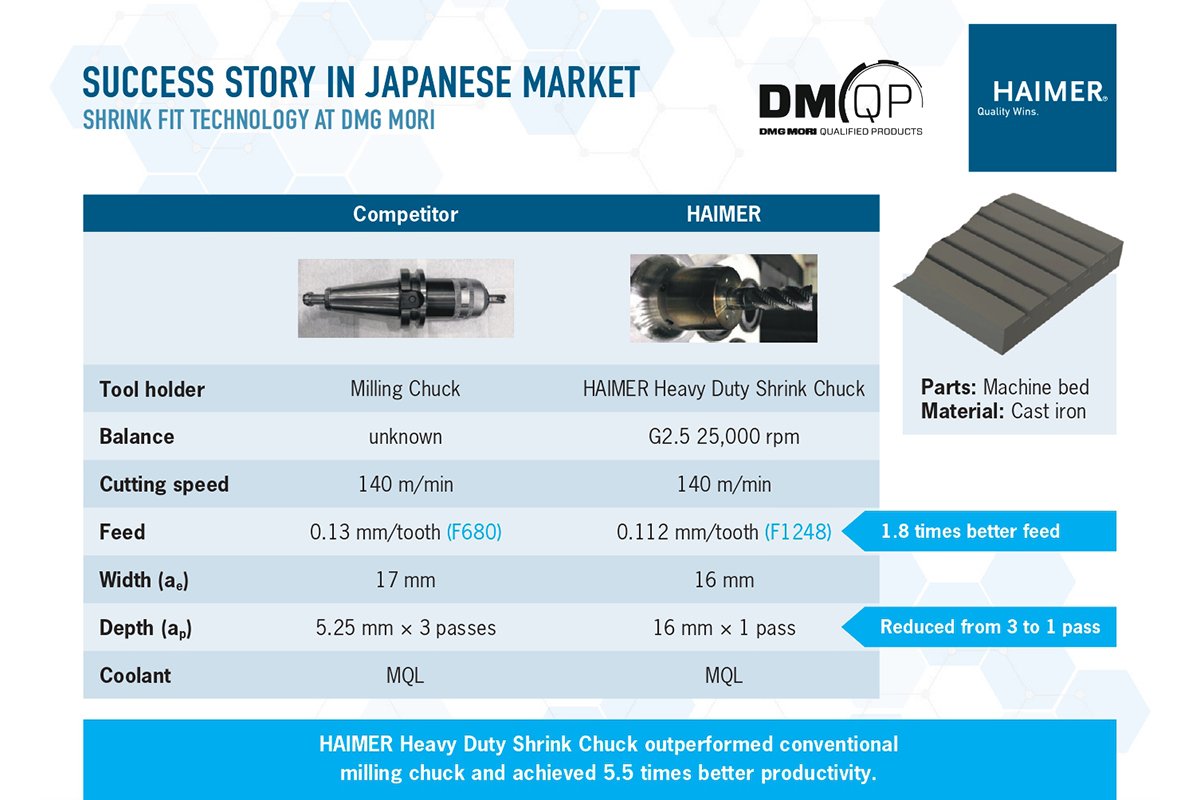
DMG MORI has also successfully replaced milling spindles with HAIMER thermally coupled spindles, achieving a significant increase in productivity of up to 5.5 times. Kazutoyo Moriguchi, Senior Executive Officer Production Engineering and Vice President DMG MORI Iga Co. Ltd., explains: "We have already seen a significant increase in productivity of 30% or more in our production by switching from traditional Japanese milling systems and collet chucks to HAIMER shrink fit technology a few years ago."

Microset Tool Presetter

Microset tool presetting technology has helped major Japanese automotive companies achieve higher precision, simpler software operations, and significantly reduced calibration cycles thanks to the thermally stable cast iron base design.

About HAIMER

HAIMER is a medium-sized, family-owned company headquartered in Igenhausen, Bavaria, near Augsburg, Germany. It develops, manufactures and sells innovative, high-precision products for metal cutting and other industries, including automotive, aerospace, energy, railways, and general machining. The product range includes a wide variety of tool holders in all common interfaces and lengths, solid carbide cutting tools, shrink fit and balancing machines, as well as 3D sensors and tool presetting machines from HAIMER Microset.
Approximately 800 employees worldwide, 500 of whom work at the production facility in Igenhausen, use state-of-the-art machines and a high level of automation. HAIMER Microset tool presetting machines are manufactured at HAIMER's second production site in Bielefeld, with approximately 50 employees. Experienced, dynamic, and highly qualified employees ensure the renowned, top-quality "made by HAIMER." As a company committed to apprenticeships, with nearly 50 apprentices and a high hiring rate, HAIMER is able to secure its future qualified employees and contribute to the further education of young adults, thus securing the future of German industry. As the European market leader in tool holding technology, with a daily capacity of approximately 4,000 tool holders, maintaining the technological edge of our products is very important to HAIMER. For this reason, each year, between 8 and 10 percent of our turnover is invested in research and development. This daily desire for improvement perfectly aligns with our corporate philosophy: quality wins.
For more information: Partnership DMG MORI e HAIMER
DMG MORI and HAIMER strengthen their global strategic partnership

Other articles that may interest you

Linde mh italia completes the acquisition of tre-p material handling torino, strengthening its prese

The acquisition of Tre-P Carrelli and its subsidiary NTP Operations consolidates Linde Material Handling's presence in Northern Italy, guaranteeing customers even more efficient and widespread services in the provinces of Turin, Vercelli, Cuneo, Biella and the Aosta Valley. Linde Material Handling Italia, the Italian subsidiary of Linde Material Handling, a world leader in the supply of intralogistics solutions, announces the completion of the acquisition of Tre-P Carrelli Srl, a historic dealer based in Turin, and its subsidiary NTP Operations Srl. The operation, initiated with the signing of a preliminary agreement on 4 November 2025, concluded with the acquisition of the shares of Tre-P Material Handling Torino Srl, a newly established company into which the business branches of Tre-P Carrelli Srl and NTP Operations Srl were merged, which takes on the new company name of Linde Material Handling Torino Srl This acquisition represents an important step in the growth and consolidation of the Linde MH brand in the Italian intralogistics market. The transaction is part of the development strategy launched two years ago with the opening of the new branches in Bolzano and Adriatica (in the province of Chieti), aimed at consolidating its direct presence in the region and further enhancing the quality of its services. With this acquisition, the company significantly strengthens its presence in the strategic Piedmont region, including the provinces of Turin, Vercelli, Cuneo, and Biella, as well as the Aosta Valley region, confirming its commitment to providing customers with an increasingly comprehensive, efficient, and structured service. "We are very pleased with this acquisition, which allows us to further consolidate the brand's presence in a key territory for the Italian market. Our customers will benefit from the quality and efficiency of Linde services," comments Luca Esposto, Vice President Sales & Service for Linde MH in Italy. " This transaction reflects our development strategy in Italy, aimed at being ever closer to our customers' needs, with innovative solutions and timely, excellent technical support," he concludes. About LINDE MH Linde Material Handling develops high-performance goods handling solutions customized to meet individual customer needs. Linde MH, in addition to being one of the world's leading manufacturers of forklifts and manual and automated warehouse equipment, offers a wide range of fleet management solutions, driver assistance systems, mobile robots and a wide variety of software solutions, consulting services and technical support. The Linde MH brand represents maximum performance, achieved through technological innovation, superior standards of ergonomics and operator safety and a wide range of energy options. In Italy, Linde MH can count on a network of 9 branches, 24 dealers and partners, and over 800 specialized service technicians, to respond promptly and effectively to customer needs.

14/04/2026 Read more

New still axl 15 igo autonomous electric pallet truck

Presented as a world premiere at LogiMAT 2026, the AXL 15 iGo automates truck loading and unloading STILL, a leading supplier of intralogistics systems and equipment, is presenting a true milestone in intralogistics at LogiMAT 2026: the first production-ready solution on the market for automating truck loading and unloading without the need for fixed safety technology at the loading bay. With the new autonomous AXL 15 iGo electric pallet truck, STILL is closing one of the last major gaps in warehouse automation: the management of incoming and outgoing goods directly at the loading bay. Automation comes to the loading bay The loading bay area is traditionally characterized by tight deadlines, staff shortages, night shifts, and challenging operating conditions, from high summer temperatures to freezing winter temperatures. Furthermore, limited space, variable trailer geometries, and very stringent safety requirements must be addressed. While many companies have long since automated warehouses, internal transport, and handling systems, truck loading and unloading has remained a process considered difficult to automate. “With the AXL 15 iGo, we're filling a historic gap in intralogistics, making automated truck loading and unloading an accessible and easily implementable standard for the first time,” explains Matteo Piantanida, Head of Sales Automation at STILL in Italy. “Our solution makes receiving and shipping goods more efficient, safe, predictable, and reliable. Process standardization enables repeatable workflows, significantly increasing operational stability and transparency. This is a key step in our strategy: to offer scalable automation solutions for every area of ​​intralogistics.” Thirty pallets in thirty-five minutes in an autonomous, flexible and safe way The AXL 15 iGo autonomous pallet truck was specifically developed for automating truck loading and unloading: two vehicles operating in tandem can autonomously load up to 30 EPAL pallets in approximately 35 minutes. Thanks to innovative localization and positioning logic integrated with a new, holistic safety concept, the truck can automatically recognize the trailer's internal configuration and precisely position the pallets. A particularly significant advantage for users is that the AXL 15 iGo does not require any fixed safety systems at the gate, such as scanners or reflectors installed on the bay or in the trailer. This makes the solution highly flexible, quick to implement, and easy to integrate into existing operations. Safety and precision in the tightest spaces To ensure safe handling and precise navigation, the AXL 15 iGo uses two complementary technologies: on the outside of the trailer, it uses Visual SLAM 3D localization technology; on the inside, it uses LiDAR-based localization, which allows for centimeter-level accuracy. The truck also integrates LiDAR safety scanners, camera systems, light and acoustic signals, and 3D pallet detection. A solution for multiple sectors The AXL 15 iGo is particularly suited to sectors with high volumes of pallets and standardized load units, such as 3PL operators, food logistics, retail, and manufacturing companies. With a load capacity of up to 1,500 kg and a speed of up to 2 m/s, the truck can meet a wide range of industrial needs. Integration into automated fleets is scalable via a VDA 5050 interface, a dedicated fleet manager, and open APIs for warehouse management systems (WMS). World premiere at LogiMAT 2026 STILL will present the AXL 15 iGo to the public for the first time at LogiMAT 2026, in Hall 10, Stands B40 and B41. The truck will be available immediately after the trade fair. “Our customers ask us for solutions that can be implemented immediately. That's why we chose to launch the product only once it was ready for rapid market release,” says Piantanida. About STILL Specializing in intralogistics solutions, STILL has a product portfolio that includes forklifts, warehouse technology, connected systems, and services. Founded in 1920 by Hans Still, the company offers customized and customer-optimized solutions, backed by excellent service. STILL's goal is to make intralogistics "intelligent," developing solutions that make warehouse operations smoother and more efficient, protect the health of workers, and simultaneously meet the highest sustainability standards. With this goal, STILL is committed to promoting new solutions for electric mobility, automation, fleet and energy management, as well as circularity, i.e., the consistent conservation and recycling of resources. Headquartered in Hamburg, STILL employs 7,100 people and is present in 89 countries. The Italian organization can count on the most solid and widespread sales and service network in the country, consisting of 10 direct branches, over 50 dealers and partners, 950 service technicians and over 170 sales representatives.

02/04/2026 Read more

Tezmaksan: making automation accessible to every factory

Cobots are changing manufacturing, but the real value comes from seamless integration Cobots have radically redefined expectations for automation, emerging as a direct response to some of the industry's most pressing pressures. Persistent labor shortages, rising production demands, and the physical limitations of traditional factory layouts have made flexibility a priority. Their appeal lies in their combination of simple integration, affordable investment levels, and the ability to operate safely. In this article, Hakan Aydoğdu, CEO of Tezmaksan Robot Technologies, a company specializing in CNC automation, reflects on how collaborative technologies are redefining automation. The latest World Robotics 2025 report highlights the rapid acceleration of this shift towards automation. Industrial robot installations reached 542,076 units in 2024, more than double the figure recorded a decade earlier. This is the fourth consecutive year in which annual installations have surpassed the half-million mark. Asia continues to dominate, accounting for nearly three-quarters of all new installations, while Europe and the Americas account for much smaller shares. These numbers reveal not only the speed of adoption but also the global imbalance in automation readiness. The global automation landscape Recent research by Make UK highlights that approximately 36% of manufacturing vacancies are difficult to fill due to a lack of candidates with the right skills, qualifications, or experience. Collaborative robots are playing an increasingly important role in filling this gap. By taking on repetitive, physically demanding, or high-risk tasks, cobots help manufacturers maintain production levels even in times of labor shortages. Cobots consistently deliver increased productivity and more reliable quality, freeing human workers to focus on complex or value-added tasks. They also help improve workplace well-being by reducing stress and injuries, and their simple programming makes automation achievable without long wait times or extensive training. For many companies, this combination accelerates the path to a measurable return on investment. Navigating the new regulations In the manufacturing sector, cobots are increasingly used to optimize assembly lines and improve operational workflows. Studies indicate that cobots can significantly improve productivity by automating repetitive tasks and allowing human workers to focus on more complex tasks that require cognitive skills. Regulatory frameworks are evolving alongside this technological momentum. The EU Machinery Regulation 2023/1230, which replaces the previous Machinery Directive, was adopted in 2023 and will be fully applicable from January 2027. It introduces a more rigorous approach to safety, liability, and cybersecurity for advanced machines and collaborative systems. The new requirements push manufacturers toward clearer accountability and more rigorous compliance processes, signaling that compliance and safer integration will become a key factor in the implementation of automation in the coming years. For engineers, this has direct implications for the design, implementation, and validation of collaborative robotic systems. In logistics environments, cobots are increasingly used for palletizing, order picking, and intralogistics material handling, where integrated vision systems, force sensors, and safety scanners enable close human-robot collaboration without traditional safety cages. In automotive manufacturing, cobots support precision assembly, screwdriving, quality control, and machine servicing, improving cycle time consistency and reducing ergonomic strain on operators. Best practices for seamless integration include conducting task-specific risk assessments in line with ISO 12100 and ISO/TS 15066, implementing safety-certified monitored shutdowns, speed and separation monitoring, and ensuring robust cybersecurity controls for connected robotic cells. Engineers are also advised to prioritize modular system architectures, standardized industrial communication protocols (such as PROFINET or EtherCAT), and digital simulation tools to validate layouts and workflows prior to physical implementation.   Challenges in legacy production environments Many manufacturing environments are aging or are built around legacy systems that weren't designed for robotics. Restricted layout plans, outdated infrastructure, or patchy connectivity can complicate integration. When new technology meets older equipment, the process can become costly or time-consuming if the two aren't seamlessly aligned. A robot's capabilities alone don't determine how collaborative automation will work. Installing and configuring robotic systems, integrating software, and maintaining everything involved can push a team beyond its current capabilities. The initial costs, from the equipment itself to facility modifications and staff training, can seem high, especially in the current economic climate. Traditional robots, typically built for fixed, repetitive tasks, often require extensive reprogramming every time they change products or layouts, resulting in downtime that can quickly erode their overall advantage. To address these limitations, manufacturers are adopting increasingly flexible automation approaches that prioritize rapid deployment, reconfigurability, and scalability of investments, especially for small and medium-sized operations. For example, the CubeBOX EcoLEAN-V1 and V2 allow systems to be repositioned and adapted as workflows evolve. This flexibility allows manufacturers to scale automation incrementally without tying production to fixed layouts. This reflects a broader shift towards agile automation, solutions designed to adapt to changing production needs. EcoLEAN is available in various configurations to support different payloads, part sizes, and space constraints, enabling deployment in a wide range of production environments. The right investment A Deloitte survey of 600 manufacturing executives in 2025 found that 80% of them plan to invest 20% or more of their improvement budgets in smart manufacturing initiatives this year, with a focus on core tools and technologies. This level of commitment signals a clear shift in the industry: manufacturers no longer view digitalization and automation as optional upgrades, but as essential capabilities that will define competitiveness in the years to come. While collaborative technology is driving this transformation, it is flexibility, mobility, and financial accessibility that will ultimately redefine how manufacturing operates and who has access to the benefits of automation.

30/03/2026 Read more
Subscribe to our newsletter
To stay updated on the latest news of the industrial world
Contact us
Image Newsletter Lindustriale
Dati Legali

L'industriale s.r.l.
P. IVA: 12212870153
Codice Fiscale: 12212870153

Sede Legale

Via Carlo Dolci, 32
20148 Milano (MI)
Italy

Registro Imprese

Iscrizione R.I.: 12212870153
REA: MI-1539011
Capitale sociale: Euro 10.400,00 i.v.

Top
This website is protected by reCAPTCHA, therefore the Google privacy policy and terms of service apply.